
Checking Criminal History in Enfield
Define the record before sending a request. Enfield Police is the source for reports its officers created. The town clerk maintains town records and provides a written-request fallback. The Halifax County Sheriff controls jail custody information, and the Clerk of Superior Court holds the case once charges are filed. For one’s own fingerprint-linked North Carolina history, use the SBI Right to Review process. There is no public SBI name-search service and no Enfield system that combines all of these products.
- Ask Enfield Police for the incident or arrest report when town officers handled the event.
- Put the public-information request in writing and send it through one of the town’s accepted delivery routes.
- Check Halifax County jail information if the person was taken into custody.
- Search eCourts Portal with Halifax selected, then contact the Clerk for the full or certified file.
- Follow SBI Right to Review when reviewing your own fingerprint-based statewide record.
This chain is more reliable than a single broad name search. It also preserves the legal difference between an Enfield police report, a county booking record, and a court disposition.
Enfield Written Records Request Process
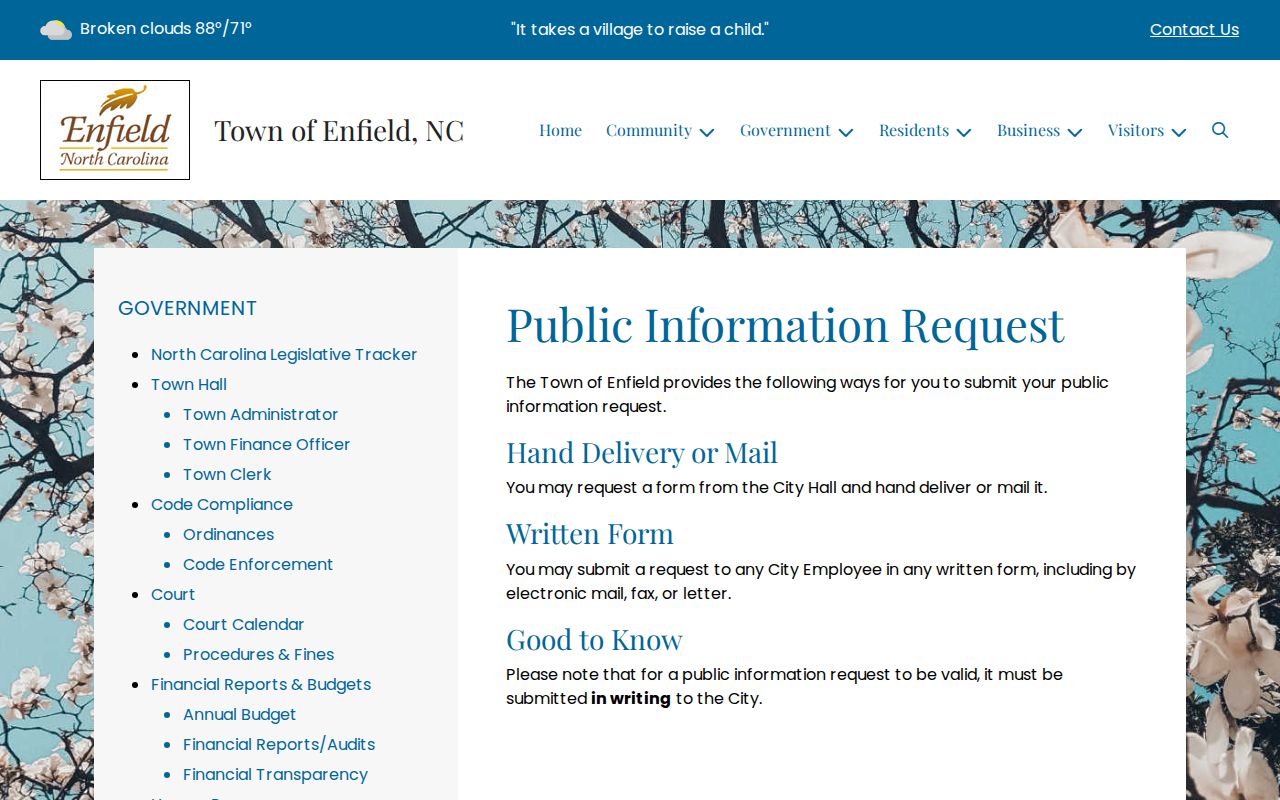
Enfield provides the clearest municipal request rule among Halifax County’s smaller towns: a valid public-information request must be in writing. A form can be obtained at City Hall and returned by hand or mail. The town also accepts another written form delivered to a city employee, an email, a fax, or a letter. The blank form and its mandatory fields were not published online, so requesters should not rely on an invented checklist.
The official Enfield public-information page controls the current method. Town Hall is at 121 SE Railroad Street, Enfield, NC 27823, with mail addressed to P.O. Box 699. Ask about the current fee, processing estimate, inspection option, and electronic delivery before choosing a format.
The official request page shows how Enfield routes written access.
This town source is the right fallback when no specialized Enfield police portal covers the requested record.
Enfield Police Department Records
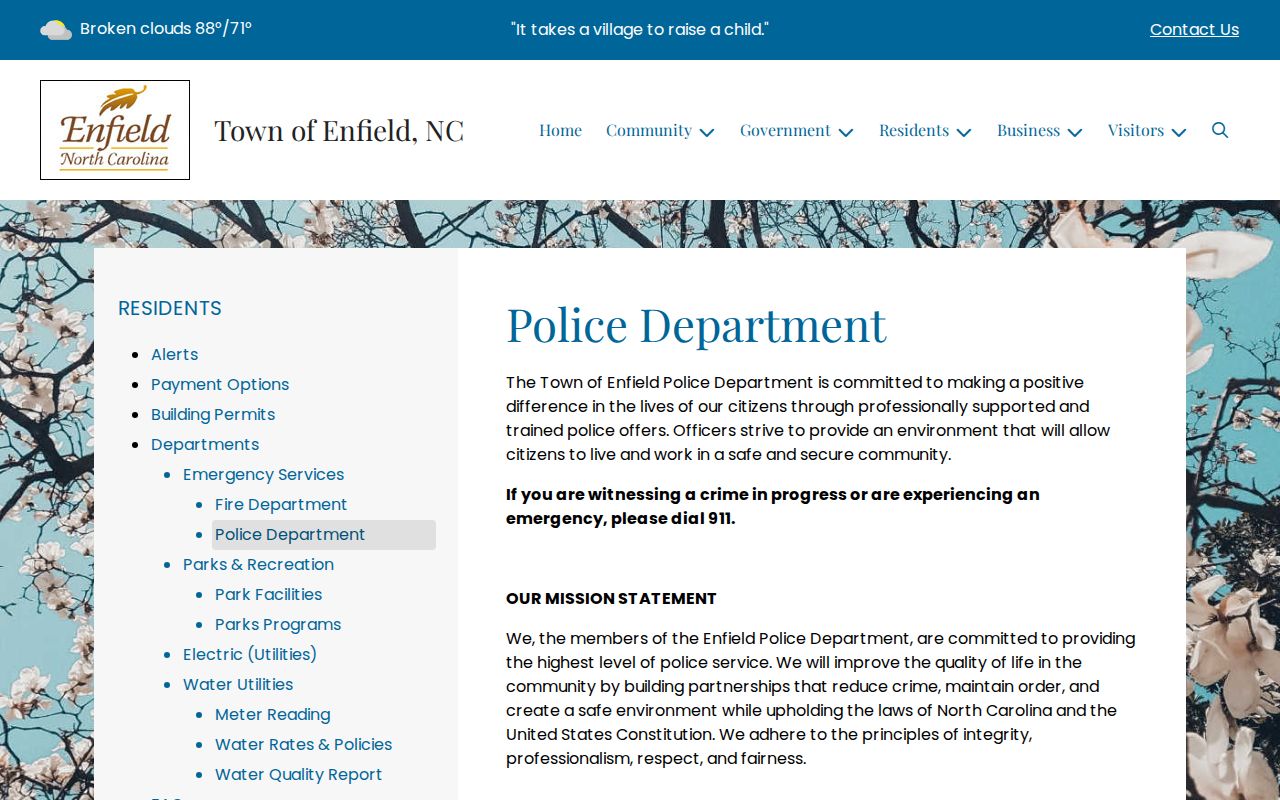
Enfield Police headquarters is at 115 SE Railroad Street. The official police page lists Chief J. Shoemaker at 252-382-1324 and jshoemaker@enfieldnc.org, plus Captain Montez Fields at 252-326-1552. Crime in progress and emergencies go to 911, not through a records request. Confirm current office availability before traveling.
Request an Enfield incident or arrest report from the police department when its officers created it. A useful request identifies the incident number if known, the event date and location, the involved person, the exact record portion, and a preferred format. Those are practical locators, not a claim that Enfield makes each field mandatory. Avoid adding Social Security numbers or other needless private data to ordinary email.
The official department page captures Enfield’s current police contact channel.
Use that department source for police-created material, then shift to county custody or court sources when the record has moved beyond town control.
Five Enfield Record Delivery Routes
The request’s written form matters more than a particular town blank. Enfield’s instructions recognize several ways to deliver it, which helps people who cannot appear at City Hall. Use a route that creates a clear copy of what was asked for and when it was submitted.
| Route | Official detail |
|---|---|
| Hand delivery | Take the written request or city form to City Hall or a city employee |
| Send a written request to the town mailing address | |
| Written email is accepted; the published clerk address is swilliams@enfieldnc.org | |
| Fax | A written fax is an accepted submission method |
| Letter or other written form | The request need not rely on a downloadable blank |
No fee or fixed processing time is published in the research. Ask for an estimate and whether inspection can meet the need before ordering copies.
Keep a copy of the request and describe the preferred format, such as inspection, electronic delivery, paper, or a certified copy if one is available. Enfield has not published a promise that every request will be completed within a fixed number of days. North Carolina law instead calls for access as promptly as reasonably possible under the circumstances. A tight date range and known incident number help the town find the record without turning the request into a search of unrelated files.
Enfield Arrests and Bookings
No official Enfield municipal jail, booking database, police arrest log, or report-search portal was located. When Enfield Police makes an arrest and detention follows, look to the Halifax County Detention Center for custody information. The county’s official inmate page changes rapidly and limits the released-person view to the prior 24 hours. The phone fallback is 252-583-3081 and requires the person’s full name.
A booking record can show intake charges, arresting agency, bond, release, and custody location. It does not establish guilt. Prosecutors may decline, replace, or amend the original police charge, and a case may have a different outcome for each count. The fuller Halifax County arrest lookup explains the county booking path without turning Enfield’s page into a jail overview.
Note: An Enfield arrest is an accusation and must never be read as a conviction without the court’s charge-level result.
Missing Enfield Crime Records Row
The SBI’s rendered 2024 agency table did not show an Enfield row. That absence is not a finding of zero crime. It means a city-specific number was unavailable in the report that researchers inspected. Countywide Halifax rates cannot be relabeled as Enfield statistics, and raw police calls cannot be treated as offenses, arrests, or convictions.
Any later comparison should name its year, agency, population source, and reporting rules. Enfield’s OSBM population estimate was 1,773 as of July 1, 2024, placing the town second among incorporated places in Halifax County. The Census Bureau place-estimate tables provide another official series, but years and vintage must match before comparison. Small raw totals can swing widely, so rates and definitions are essential before drawing a trend.
Municipal Court Records in Enfield
Enfield has no municipal criminal court. Local ordinance matters, traffic cases, misdemeanors, and preliminary felony stages use North Carolina District Court; felony trials use Superior Court. The Halifax County Clerk holds those files. Search the North Carolina eCourts Portal with Halifax as the location, then contact the Clerk at 252-593-3000 when the file is old, unscanned, unclear, or needs certification.
| Court Name | Halifax County District Court or Superior Court |
|---|---|
| Case Types Heard | District Court hears misdemeanors, infractions, and early felony matters; Superior Court hears felony trials |
| Case Lookup Channel | eCourts Portal, Halifax Clerk terminal, and Clerk file request |
| What the Docket Shows | Case number, charges, dates, status, hearings, dispositions, judgment, and public costs |
| Copies & Fees | The Clerk supplies available copies and certified records at the current applicable charge |
The Enfield magistrate line, 252-445-2961, can help with initial-process questions but is not a complete case-record source.
Enfield Records and Local History
Enfield describes itself as Halifax County’s oldest town, founded in 1740 and once known as Huckleberry Swamp. The 1759 Enfield Riot arose when residents seized land agent Francis Corbin over allegedly unlawful fees. That event is local justice history, but it does not change where modern records are held. Today’s police files begin with the town, while prosecution files sit in the state-run county courts.
Later growth as a tobacco market and then a major raw-peanut market remains visible in Enfield’s civic identity and Peanut Festival. Historical research may therefore use town material for local context while using Clerk files for modern criminal proceedings. Keeping those collections distinct prevents an archive or local-history source from being mistaken for a current criminal-record portal.
Where Enfield Records Go
An Enfield officer creates the incident or arrest report. If detention follows, Halifax County booking staff record the arresting agency, intake charges, identifiers, bond, and custody facts. The prosecutor then decides what charge enters court, and the Clerk records hearings, pleas, dispositions, judgments, and sentence. Reported outcomes can later connect with the fingerprint-based arrest cycle in the state repository.
Record flow: Enfield Police › Halifax County Courts › North Carolina State Bureau of Investigation
Timing differs at each step. Town police may have the earliest report, the jail may have the newest custody fact, and Portal may lag until a case is filed. The SBI record serves a different purpose and is not an open public name lookup. Choose the newest responsible custodian for a recent event, then verify the final outcome with the Clerk.
Enfield Town Clerk Records Fallback
The town clerk maintains Enfield records and provides a clear fallback when no department-specific web form exists. The published clerk email is swilliams@enfieldnc.org. State the exact record sought, a narrow date span, the relevant location, and an incident or case number if known. Ask which department holds it rather than demanding an undifferentiated criminal file.
The clerk may route a police request to the right town custodian, but cannot supply Halifax jail booking data or certify a state court judgment. Those requests belong to the Sheriff and Clerk of Superior Court. This boundary is useful: it keeps Enfield’s written process focused on documents the town actually created or received.
New Enfield Records Before Portal
A fresh Enfield arrest may not appear in eCourts at once because an arrest charge is not yet a filed court charge. First contact the police department for its report and the detention center for present custody. Search Portal again after prosecutors have acted. Once a docket appears, record the case number, division, filing date, each charge, and each disposition.
Never treat a same-name result as a confirmed identity. Compare middle name, lawful birth or age descriptors, filing dates, county, and docket number. “Disposed” only means the case has ended; the charge-level line still must say whether the result was guilty, dismissed, not guilty, or another North Carolina outcome.
If Portal lacks an expected result, use the Clerk’s public terminal or ask for the paper file. Some older or unscanned items require counter retrieval. A calendar can confirm a hearing date, but it is not the full docket and should not be used as the final case outcome.
Public Access Rules in Enfield
Enfield’s written-request policy works within North Carolina law. Public access does not make every investigative note open. Active investigation details, protected victim data, juvenile information, confidential sources, security-sensitive facts, and expunged material may be withheld or redacted. Court records follow the Clerk’s access law, while SBI criminal-history dissemination is limited by separate authority.
Key Statutes:
North Carolina Public Records Law - G.S. 132-1 and 132-6 govern inspection and copies at reasonable times, subject to exceptions.
G.S. 132-1.4 - criminal investigation records receive special treatment, with tailored access to certain incident and arrest facts.
G.S. 7A-109 - Clerk records generally are open for inspection unless a statute restricts them.
If Enfield withholds a requested portion, ask for the legal basis and whether a redacted record can be released. The specific record description matters more than a broad demand for all criminal information.